

What Analytics Should a Business Track Inside Its Mobile App?
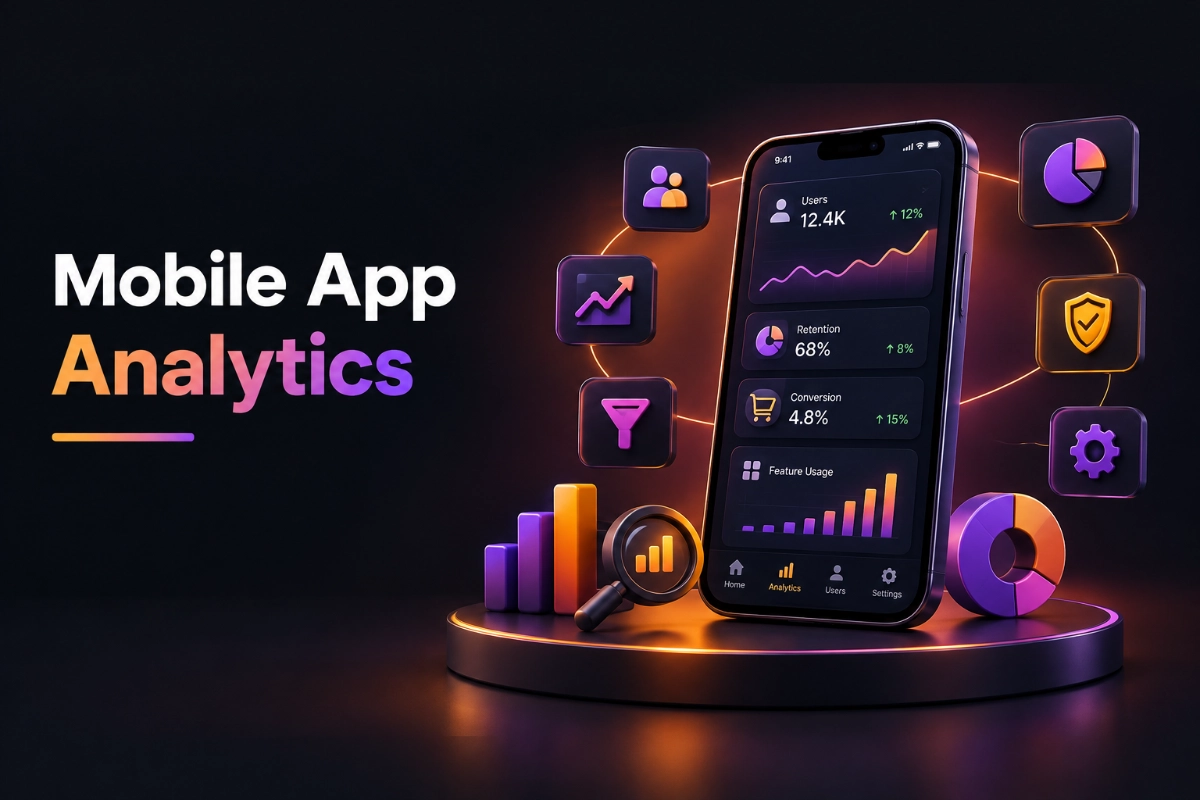
Businesses should track mobile app analytics that explain how users discover, navigate, engage with, and convert inside the application. Important metrics include activation rate, retention, session behavior, feature usage, conversion rate, funnel drop-offs, crashes, performance, and customer lifetime value. The right metrics depend on the app’s business model and its primary goals.
Installing an analytics platform is only the first step. Businesses need to identify which events and metrics actually support product and business decisions.
Why Is Mobile App Analytics Important?
A mobile application generates large amounts of behavioral data. Every login, search, product view, purchase, form submission, and interaction can provide information about how users experience the product.
Without analytics, businesses may know that people are downloading the app but not understand why users stop using it.
Analytics can answer questions such as:
- Where do users leave the application?
- Which features are used most?
- How many users complete registration?
- Which screens cause friction?
- How often do customers return?
- Which actions lead to purchases?
- Does a new feature improve engagement?
- Are crashes affecting specific devices or operating systems?
This information helps product teams make decisions based on actual user behavior rather than assumptions.
Which Mobile App Metrics Should Businesses Track?
1. Activation Rate
Activation measures how many new users complete the key action that indicates they have reached the app’s initial value.
The exact activation event depends on the application.
For an ecommerce app, activation might involve viewing products or completing the first purchase. For a project management application, it might be creating the first project.
Tracking activation is often more useful than simply counting downloads.
2. User Retention
Retention shows whether users continue returning after their first interaction.
Businesses can examine retention over different periods, such as the first day, week, or month.
Low retention can indicate problems with product value, onboarding, usability, performance, or engagement.
Retention should therefore be considered alongside other metrics rather than viewed in isolation.
3. Session Duration and Frequency
Session duration shows how long users typically remain active, while session frequency shows how often they return.
Longer sessions are not automatically better. A banking customer may complete their task in two minutes and leave, which could be a sign of an efficient application.
These metrics need to be interpreted according to the app’s purpose.
4. Feature Usage
Businesses should know which features users actually use.
Feature analytics can identify:
- Popular functionality
- Underused features
- Features with high abandonment
- Differences between new and returning users
- Features associated with conversions
This can influence future development priorities.
Instead of spending development resources equally across every feature, businesses can focus on functionality that creates measurable value.
How Should Businesses Track the Mobile App Conversion Funnel?
Conversion tracking is particularly important for ecommerce, subscription, booking, and lead-generation applications.
A funnel might look like:
Product View → Add to Cart → Checkout → Payment → Purchase
Analytics can show where users stop progressing.
If many users add products to their cart but abandon the checkout process, the issue may involve payment options, account requirements, unexpected costs, technical errors, or a complicated checkout experience.
For a service application, the funnel might instead be:
Landing Screen → Service View → Form → Lead Submission
The same principle applies.
Should Businesses Track App Crashes and Performance?
Yes. Business analytics should not focus only on marketing and user behavior.
Technical performance data is equally important.
Useful metrics include:
- Crash frequency
- Crash-free users
- App startup time
- Screen loading time
- API response time
- Failed network requests
- Error rates
- Device-specific issues
- Operating system-specific problems
A technically unstable application can lose users even when the product itself is valuable.
Combining behavioral and technical analytics can reveal relationships between performance and user abandonment.
What User Behavior Should Be Measured?
Event tracking allows businesses to understand specific interactions within the application.
Examples include:
- Searches
- Button clicks
- Screen views
- Product views
- Video plays
- Form submissions
- Downloads
- Logins
- Purchases
- Subscription changes
- Notification interactions
The objective is not to track everything simply because it can be tracked. Events should be selected based on the business questions the team needs to answer.
How Can Analytics Improve Mobile App Development?
Analytics should influence the development roadmap.
Suppose data shows that users frequently access one feature but struggle to complete the next step. Developers and UX teams can investigate that workflow.
Similarly, if a feature has extremely low adoption, the business can determine whether the problem is poor visibility, confusing UX, lack of user need, or technical limitations.
This creates a continuous cycle:
Measure → Identify Problem → Improve → Release → Measure Again
That cycle is one of the most valuable roles of analytics in modern mobile app development.
What About Customer Lifetime Value?
For apps with purchases, subscriptions, or recurring revenue, customer lifetime value can help businesses understand the long-term financial contribution of users.
It can be combined with acquisition and conversion data to understand whether marketing and product investments are generating sustainable returns.
For example, a campaign may generate many downloads but relatively few paying customers. Analytics can reveal the difference between acquisition volume and actual business value.
Key Takeaways
- Mobile app analytics should measure both user behavior and technical performance.
- Activation and retention are more meaningful than download numbers alone.
- Funnel analytics can identify exactly where users abandon important workflows.
- Feature usage helps prioritize future development.
- Crash, loading, and API performance data can reveal technical problems.
- Analytics should support product decisions rather than simply generate reports.
Final Thoughts
Mobile app analytics turns user activity into actionable information. The goal is not to collect the largest possible amount of data. It is to track the right events, understand user behavior, identify problems, and continuously improve the application.
organix-IT can help businesses build mobile applications with analytics, backend integrations, performance monitoring, and scalable architecture included as part of the development strategy. The right analytics setup gives product and business teams the visibility they need to improve the app after launch.


Hire Developer