

How Do Mobile Apps Connect With Existing Business Systems Through APIs?
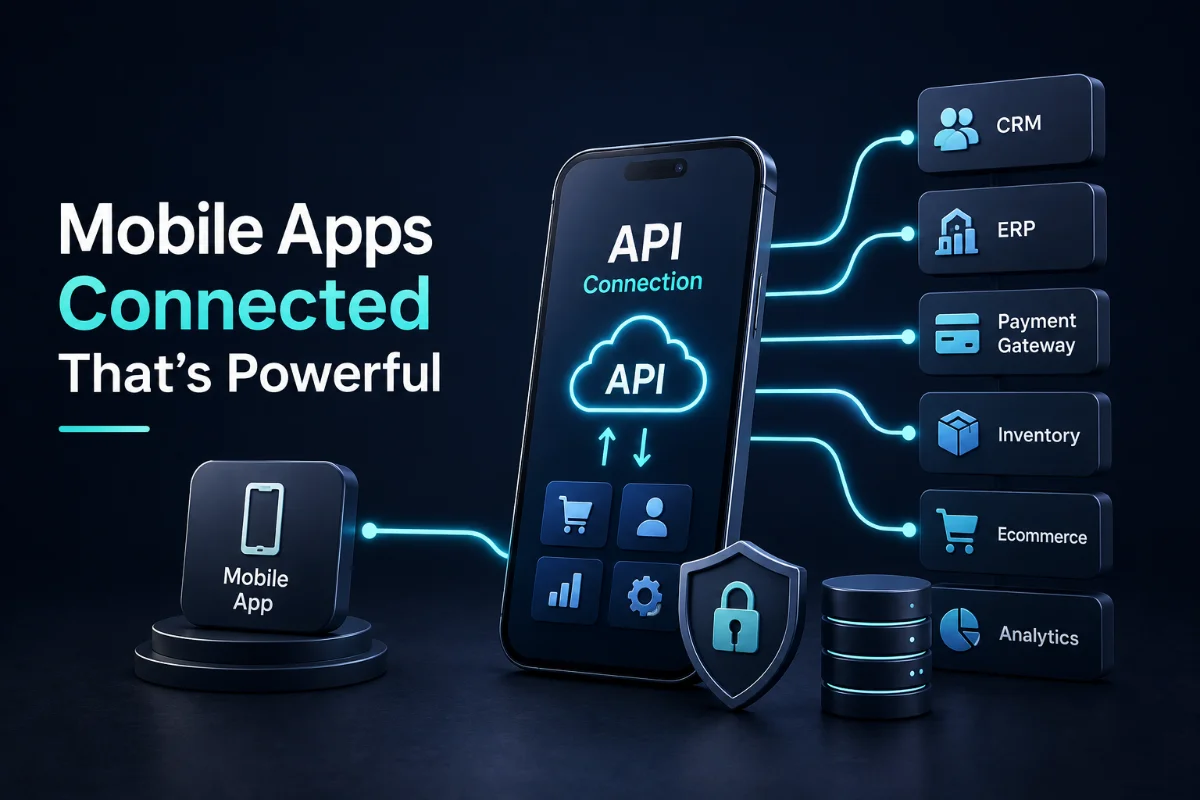
Mobile apps connect with existing business systems through APIs (Application Programming Interfaces), which allow different software platforms to securely exchange data and functionality. An API can connect a mobile application with CRMs, ERPs, payment gateways, ecommerce platforms, inventory systems, booking software, or custom databases without requiring the mobile app to directly access the underlying system.
For businesses, this means a mobile application doesn’t necessarily need to operate as a separate system. Instead, it can become another interface through which customers, employees, sales teams, or partners interact with existing business infrastructure.
Why Is API Integration Important for a Business Mobile App?
API integration prevents businesses from creating disconnected systems that require information to be entered and maintained multiple times.
For example, an ecommerce business may already have products, customer accounts, orders and inventory managed through its existing platform. A mobile application can connect to these systems through APIs and retrieve the required information in real time.
When a customer places an order through the app, the API can send that order to the relevant backend system. Inventory can then be updated, payment information processed, and order status returned to the mobile application.
This creates a connected workflow rather than forcing the business to maintain separate mobile and web databases.
What Business Systems Can a Mobile App Connect With?
A mobile application can potentially integrate with almost any system that provides a suitable API.
Common integrations include:
- CRM and customer management platforms
- ERP and accounting systems
- Ecommerce platforms
- Payment gateways
- Inventory and warehouse management systems
- Booking and appointment platforms
- Shipping and logistics services
- Marketing automation tools
- Authentication providers
- Analytics platforms
- AI and third-party services
The integration approach depends on the technology, API architecture, authentication method and data requirements of each system.
How Does API Integration Work?
Typically, the mobile application communicates with a backend layer rather than directly connecting to every external service. The backend handles authentication, business logic, data validation and communication with external APIs.
For example, when a user requests their order history, the mobile application can send a request to the backend. The backend authenticates the request, retrieves the relevant information from the connected system and returns only the required data to the application.
This architecture provides greater control over security and makes it easier to manage multiple integrations as the business grows.
What Should Businesses Consider Before Integrating an API?
API integration should be planned around security, reliability, scalability and future maintenance.
Authentication and authorization must ensure that users can access only the information they are permitted to see. Sensitive data should be encrypted during transmission, while API requests should be validated and monitored.
Businesses should also consider what happens when an external API becomes unavailable. Proper error handling, retry mechanisms, logging and fallback processes can prevent a temporary integration problem from completely disrupting the application.
A well-designed API architecture also makes future expansion easier. New payment providers, business systems, AI services or operational tools can be integrated without redesigning the entire application.
Key Takeaways
- APIs allow mobile apps to communicate with existing business systems.
- CRM, ERP, ecommerce, payment and inventory platforms can commonly be integrated.
- A backend layer can provide better security and control over multiple integrations.
- Reliable API architecture supports real-time workflows and reduces duplicate data entry.
- Integration should consider security, scalability, error handling and future maintenance.
Final Thoughts
A mobile application becomes significantly more valuable when it works as part of the wider business ecosystem. Instead of creating another isolated platform, API integration can connect your mobile experience with the systems your business already depends on.
Are you planning a mobile app that needs to connect with your existing CRM, ERP, ecommerce platform or custom software?
organix-IT can design and develop API-driven mobile solutions that integrate your digital systems into a connected, scalable business environment. Discuss your requirements with our development team to determine the right integration architecture for your project.
Hire Developer