

When Should a Business Choose Native App Development Over Cross-Platform?
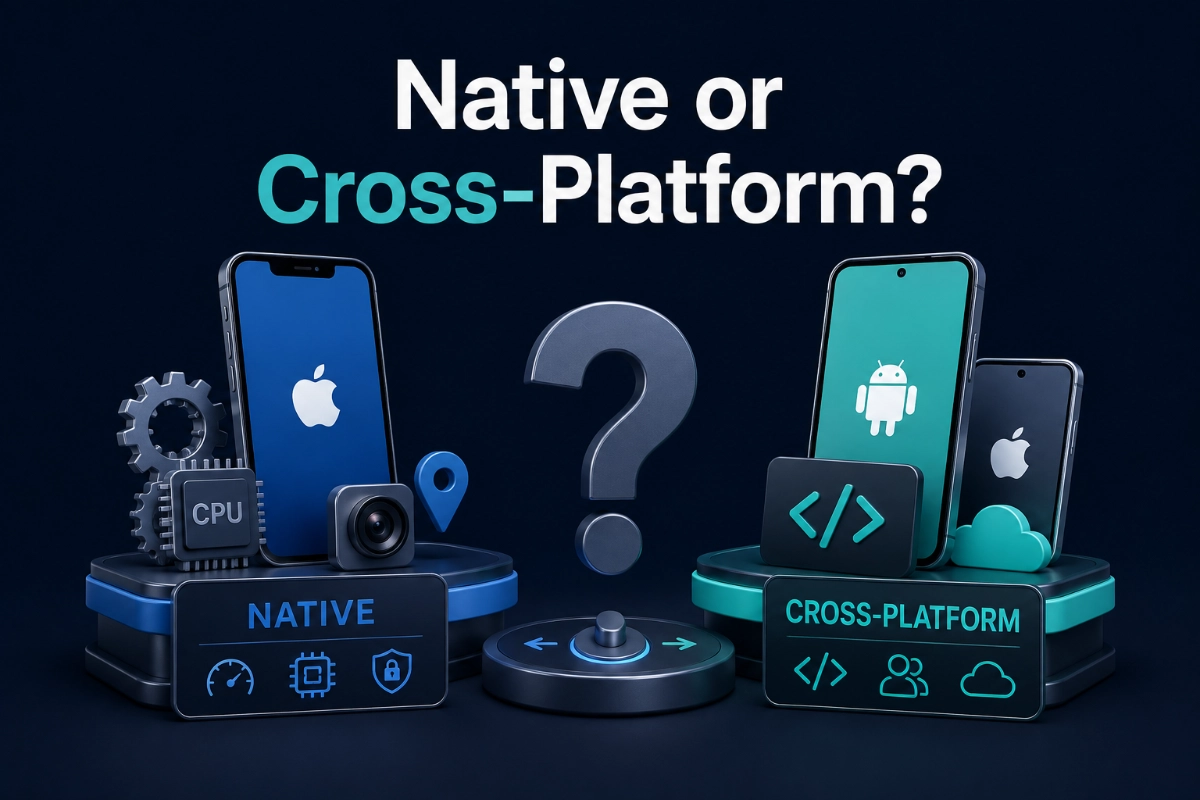
Businesses should consider native app development when an application requires maximum platform-specific performance, deep access to device capabilities, complex graphics, advanced hardware integration, or highly optimized user experiences. Cross-platform development can be more efficient when the application needs to run on both iOS and Android with shared code and has standard functionality.
The decision isn’t simply about choosing between two technologies. It should be based on the application’s requirements, target users, development budget, expected performance, integration needs, and long-term maintenance strategy.
What Is Native Mobile App Development?
Native development means building an application specifically for an operating system using its preferred development technologies.
For iOS, this commonly means Swift and Apple’s development ecosystem. For Android, developers typically use Kotlin and Android’s native tools.
Because native applications are designed specifically for their target platform, developers have direct access to operating system capabilities and platform-specific APIs. This can provide greater control over performance, animations, hardware functionality, background processing, security features, and user interface behaviour.
Native development is particularly valuable when these capabilities are central to the application’s purpose.
When Does Native Development Make More Sense?
One major reason to choose native development is performance.
Applications involving intensive graphics, video processing, augmented reality, advanced animations, real-time communication, or complex device interactions may benefit from platform-specific optimization.
Native development can also be a strong choice when an application depends heavily on device hardware. Applications using Bluetooth, GPS, cameras, biometric sensors, NFC, or other hardware capabilities may require deeper platform integration.
Another consideration is user experience. iOS and Android have different interface conventions and interaction patterns. A native development approach allows developers to design the experience specifically for each platform rather than attempting to maintain one interface across different operating systems.
Native development may also be appropriate for applications where long-term platform control is more important than minimizing initial development effort.
When Is Cross-Platform Development the Better Choice?
Cross-platform development allows businesses to create applications for multiple operating systems using a shared codebase. Technologies such as React Native and Flutter can significantly reduce duplicated development work.
This approach is often suitable for business applications such as ecommerce platforms, booking systems, customer portals, delivery applications, internal business tools, and content-driven applications.
The biggest advantage is development efficiency. Instead of maintaining completely separate codebases for iOS and Android, a business can share a substantial portion of its application logic and functionality.
This can reduce initial development time and simplify maintenance, particularly when the application doesn’t require extensive platform-specific functionality.
However, cross-platform doesn’t mean “build once and never think about the platforms again.” Developers still need to test applications across devices and operating systems and may need native code when platform-specific functionality is required.
What Should a Business Consider Before Choosing?
The decision should begin with requirements rather than technology preferences.
Ask:
- Does the application require advanced device hardware?
- Is maximum performance critical?
- Does the app require complex animations or graphics?
- How quickly does the business need to launch?
- What is the available development budget?
- Will the application require frequent feature updates?
- Does the product need identical functionality across iOS and Android?
- What integrations will the application require?
A simple business application may not justify the additional development effort of two separate native codebases. Conversely, an application where performance and device-level capabilities are central may benefit considerably from native development.
Key Takeaways
- Native development provides greater platform-specific control and optimization.
- Cross-platform development can reduce duplicated development effort.
- High-performance and hardware-intensive applications may benefit from native technology.
- Standard business applications can often work effectively with cross-platform frameworks.
- The correct choice depends on requirements, not simply development cost.
- Both approaches can produce high-quality applications when properly architected and tested.
Final Thoughts
There is no universally superior approach to mobile application development. Native and cross-platform technologies both have legitimate advantages, and the right choice depends on what the application needs to accomplish.
The most important step is to evaluate the product requirements before selecting a framework. A development partner should be able to explain the technical trade-offs and recommend an approach based on performance, scalability, budget, user experience, and long-term maintenance—not simply recommend the technology they happen to use.
Planning an iOS, Android, or cross-platform application? organix-IT can assess your requirements and recommend the development architecture and technology approach that best fits your business goals.



Hire Developer