

Should You Build an MVP or a Full Mobile App From Day One?
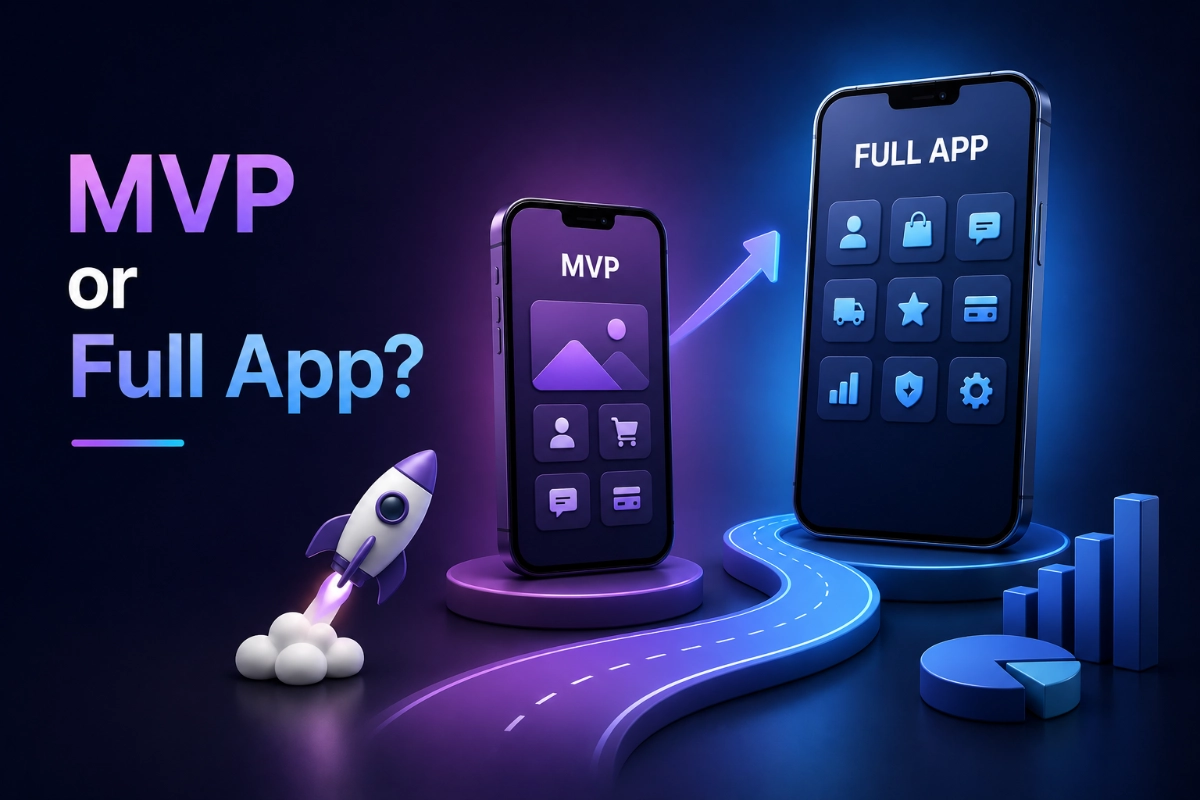
For most businesses launching a new mobile application, building an MVP (Minimum Viable Product) first is a practical way to validate the idea before committing significant resources to a complete application. An MVP focuses on the core functionality needed to solve the primary user problem, collect real-world feedback, and determine whether the product has genuine market demand.
However, an MVP isn’t automatically the right choice for every project. Businesses with established customers, well-defined requirements, regulatory obligations, or proven demand may benefit from developing a more complete application from the beginning. The right approach depends on your product maturity, business goals, budget, technical requirements, and expected users.
What Is an MVP in Mobile App Development?
A mobile app MVP is an initial version containing the minimum set of features required to deliver the application’s core value.
For example, imagine a business wants to build a food delivery application. A full product might eventually include customer accounts, restaurant management, delivery tracking, loyalty programs, promotions, reviews, multiple payment methods, analytics, customer support, and AI-powered recommendations.
An MVP might initially focus on customer registration, restaurant browsing, menu selection, ordering, payment, and basic order tracking.
The objective isn’t to build a poor-quality application. A properly planned MVP should still be secure, usable, reliable, and technically sound. The difference is that it avoids spending resources on features that haven’t yet been validated.
When Does Building an MVP Make More Sense?
An MVP is particularly useful when the business is entering a new market or testing an unproven product idea.
It allows you to put the application in front of real users, monitor behaviour, collect feedback, and identify which features actually matter. This can prevent businesses from investing heavily in functionality that users rarely use.
MVP development can also help startups demonstrate a working product to investors, partners, or early customers. Instead of presenting only an idea, the business can demonstrate a functioning solution and use real usage data to guide the next development phase.
Another advantage is flexibility. Once users begin interacting with the product, development priorities can be adjusted based on evidence rather than assumptions.
However, the MVP approach still requires proper architecture. Cutting features should not mean cutting essential security, performance, scalability, or testing requirements.
When Should You Build the Full Mobile App?
A complete application may make more sense when your business already understands its customers and has clearly defined requirements.
For example, an established company replacing an existing customer portal may already know which features users require. Building a limited MVP could create unnecessary disruption when the business already has validated workflows.
Some applications also require substantial infrastructure from the beginning. Healthcare, financial, logistics, enterprise, and other data-sensitive applications may need comprehensive security, integrations, reporting, permissions, and compliance controls before they can deliver meaningful business value.
The same applies when the mobile application is only one part of a larger software ecosystem. If the application must communicate with an ERP, CRM, warehouse management platform, payment gateway, or other business systems, the initial architecture needs to account for those integrations.
How Should You Decide Between an MVP and a Full App?
Start by identifying the core problem the application is expected to solve.
Then separate requirements into three groups:
- Essential features required for the first release.
- Features that improve the product but can come later.
- Features that are ideas requiring user validation.
This exercise often reveals that an MVP can deliver the core business value without requiring the complete feature roadmap.
At the same time, your development team should design the underlying architecture with future expansion in mind. A successful MVP should provide a foundation for the next version rather than becoming disposable software that must be rebuilt.
Key Takeaways
- An MVP is useful for validating new products and reducing unnecessary initial development.
- A full application can make sense when requirements and market demand are already established.
- MVP does not mean low-quality or insecure software.
- Core architecture should consider future scalability even when the first release is limited.
- User feedback and real-world data should guide future feature development.
Final Thoughts
The decision between an MVP and a full mobile application should be based on business certainty, product complexity, available resources, and long-term goals. Building everything from day one can consume substantial time and budget, while an overly limited MVP may fail to deliver enough value to users.
The strongest approach is usually to define a clear first-release scope, build the essential functionality properly, measure real-world results, and expand based on evidence.
Planning a new mobile app but unsure where to start? organix-IT can help you define the right MVP scope, technology approach, architecture, and development roadmap for your business.
Hire Developer