

What Features Should Every Business Mobile App Include? A Practical Guide for Better User Experience
A mobile application is more than a digital extension of your business it is often the primary touchpoint between your brand and your customers. Whether you’re developing an ecommerce platform, healthcare solution, logistics application, booking system, or customer portal, the features you choose will directly influence user engagement, retention, and long-term success.
Many businesses focus on adding as many features as possible, believing that more functionality creates a better product. In reality, successful mobile applications prioritize usability, performance, and solving specific user problems. Every feature should have a clear purpose and contribute to a seamless user experience.
What Are the Must-Have Features of a Modern Business Mobile App?
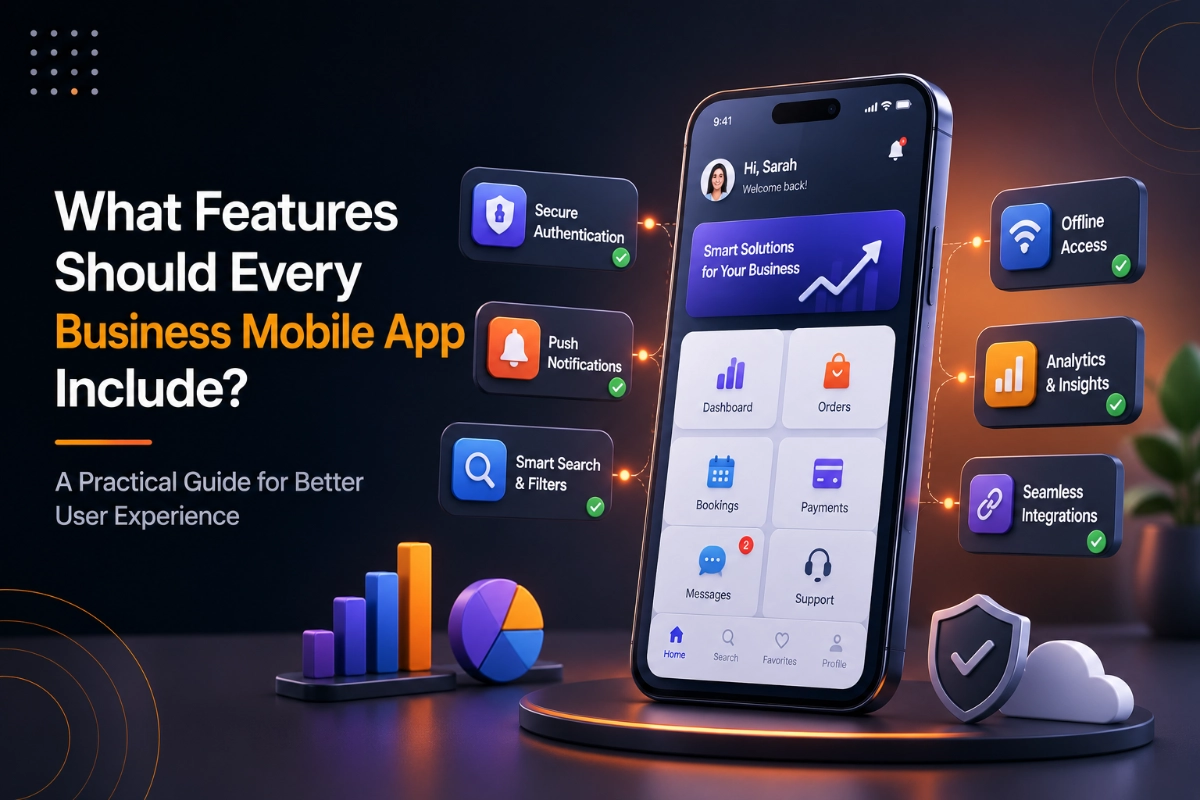
Every successful business mobile app should include secure user authentication, intuitive navigation, push notifications, powerful search functionality, offline accessibility where needed, real-time analytics, and seamless API integrations. While the exact feature set depends on your business goals and target audience, these core capabilities improve user experience, strengthen security, increase engagement, and support long-term scalability.
It depends on your industry and business objectives, but several features have become essential across most modern business applications.
A secure user authentication system is the foundation of any application handling customer information. Whether through email, phone verification, Single Sign-On (SSO), or biometric authentication, users expect a secure and convenient login experience.
Push notifications continue to be one of the most effective engagement tools when used strategically. They help businesses share order updates, appointment reminders, promotions, and personalized alerts without overwhelming users.
Search and filtering capabilities are equally important, particularly for applications managing large volumes of products, services, or content. Users should be able to find what they need quickly without unnecessary navigation.
Offline functionality is another valuable feature. Allowing users to access essential information or continue using parts of the application without an internet connection improves reliability and enhances the overall experience.
Real-time analytics and reporting enable businesses to understand user behavior, measure engagement, and make informed decisions for future improvements. Collecting meaningful insights helps optimize both the application and business processes over time.
Features That Differentiate Modern Mobile Applications
Beyond the core functionality, today’s users expect applications to deliver convenience, speed, and personalization.
Integration with payment gateways allows businesses to offer secure online transactions directly within the application. AI-powered chat assistants and live chat features improve customer support while reducing response times.
Location services can provide personalized recommendations, delivery tracking, nearby branch information, or location-based notifications. Social login options simplify registration and reduce friction during onboarding.
Cloud synchronization ensures users can seamlessly access their data across multiple devices, while API integrations connect the mobile application with CRMs, ERPs, inventory systems, marketing platforms, and other business software.
As businesses grow, scalability should also be considered from the beginning. Choosing an architecture that supports future feature expansion prevents expensive redevelopment later.
The most successful applications aren’t necessarily those with the highest number of features; they’re the ones that deliver the right features efficiently and reliably.
Key Takeaways
- Prioritize features that solve real customer problems.
- Secure authentication and data protection should never be optional.
- Push notifications, search, and offline access significantly improve usability.
- API integrations and cloud synchronization create a connected digital ecosystem.
- Build with scalability in mind to support future business growth.
Final Thoughts
A well-designed mobile application balances functionality with simplicity. Instead of trying to include every possible feature, businesses should focus on delivering meaningful experiences that help users achieve their goals quickly and securely.
By identifying your users’ needs early and selecting features that align with your business objectives, you can create an application that delivers lasting value while remaining adaptable to future growth.
Looking to build a feature-rich mobile application tailored to your business?
organix-IT develops custom mobile applications that combine intuitive user experiences, secure architecture, and scalable technology to help businesses deliver better digital experiences and achieve long-term success.

Hire Developer